We conducted an assessment of impacts, risks and opportunities across the sustainability topics and subtopics set out in the European Sustainability Reporting Standards (ESRS) to align our reporting with the EU sustainability reporting framework.
Our approach to sustainability is underpinned by our Sustainability Policy and 2025–2030 Sustainability Strategy. The Policy sets out the fundamental principles of responsible business that guide our operations, while the Strategy defines our priorities and measurable goals and explains how we translate these principles into concrete actions and results.
The documents listed below are currently available in Croatian only. English-language versions of selected corporate documents will be made available progressively.
The core principles and commitments guiding how we manage our environmental, social and governance impacts.
Our strategic priorities, measurable goals and direction for developing our sustainable business through 2030.
Strategic sustainability goals
Drawing on our strategic focus on renewable energy development, we defined our sustainability goals by integrating the relevant regulatory framework (the EU Green Deal, the CSRD and the EU Taxonomy), the findings of our double materiality assessment and the expectations of key stakeholders. This approach enabled us to identify the areas in which we have the greatest actual and potential impact and translate them into four measurable, operationally achievable sustainability goals.

The targets are based on business strategy, which envisages increasing installed solar and wind power capacity by 100 MW by 2030. In 2024, the Group operated wind farms with a total installed capacity of 142 MW and generated 280 GWh of electricity. Electricity generation from wind and solar is expected to increase by 50%, reaching 420 GWh by 2030. Key activities for achieving the target include the continued development of projects and alignment with expert recommendations on technical and environmental measures.
By generating energy from renewable sources, we help avoid emissions that would otherwise be released through the use of fossil fuels. The amount of avoided emissions is proportional to renewable energy generation. In 2024, the Group operated a portfolio consisting exclusively of wind farms, with a total installed capacity of 142 MW. The planned 100 MW increase in installed capacity therefore underpins the target of increasing avoided emissions by 50% by 2030 compared with 2024.
Continuous investment in employees' knowledge and skills is an important part of the Company's development. Through training, professional development and competency building, we support employees’ professional growth and strengthen the knowledge and skills needed for the Company’s continued development.
Responsible business conduct in the value chain is one of the areas to which the Company pays particular attention. The Supplier Code of Responsible Business Conduct sets out principles and expectations relating to responsible and ethical business conduct, respect for human and labour rights, occupational health and safety, environmental protection, personal data protection, information and cybersecurity, as well as confidentiality and the protection of business information. The goal is for at least 80% of suppliers to sign the Code by 2030, thereby progressively embedding its principles into supplier relationships and business practices across the value chain.
Alignment with the UN Sustainable Development Goals
The UN Sustainable Development Goals are embedded in EU sustainability policy and underpin the sustainability-related requirements of the CSRD, the ESRS and the EU Taxonomy. They therefore provide an appropriate framework for developing our Sustainability Strategy. This also reflects common market practice, whereby companies select the goals most relevant to their business model.
Below, the material topics identified by Professio Energia Group are mapped to the relevant Sustainable Development Goals adopted under the United Nations 2030 Agenda for Sustainable Development in 2015.
Goals, material topics and standards
 CLIMATE ACTION
Climate change adaptation, climate change mitigation
CLIMATE ACTION
Climate change adaptation, climate change mitigation
 AFFORDABLE AND CLEAN ENERGY
Energy
AFFORDABLE AND CLEAN ENERGY
Energy
 LIFE ON LAND
Impacts on species status
LIFE ON LAND
Impacts on species status
 RESPONSIBLE CONSUMPTION AND PRODUCTION
Resource inflows, including resource use
RESPONSIBLE CONSUMPTION AND PRODUCTION
Resource inflows, including resource use
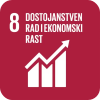 DECENT WORK AND ECONOMIC GROWTH
Working conditions, civil and political rights of communities, corporate culture
DECENT WORK AND ECONOMIC GROWTH
Working conditions, civil and political rights of communities, corporate culture
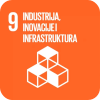 INDUSTRY, INNOVATION AND INFRASTRUCTURE
Cybersecurity
INDUSTRY, INNOVATION AND INFRASTRUCTURE
Cybersecurity